160
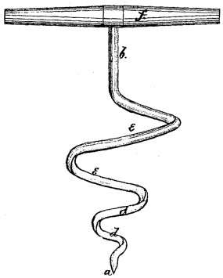
Left: The first patent was
number 112,959 issued on
March 21, 1871 to Ennis A.
Raymond of Waterloo, Iowa.
His lifter was a helix with
gradually increasing spiral
diameter from point to top. To
make his lifter he starts with
about a five foot half-inch rod
and bends it into a 9
‖
long
spiral with a four inch diameter
at the basis.
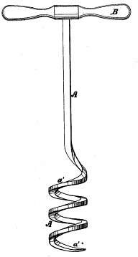
Right: The next patent was
number 137,622 issued on April 8, 1873 to Cornelius
Ragan of Waterloo, Iowa. He used a pointed 3/8 inch square bar to form his helix with
his spiral diameter changing from 3 1/2 inches at the tip to 3 inches at the shank. His
overall length was 18-20 inches.
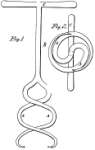
Patent number 144,147 was issued on October 28, 1873 to John F.
Schmeltzer and Joseph M. Roberts of Winona, Minnesota for a
double-helix lifter. They also had their spiral diameter gradually
change, being greatest at the tip.
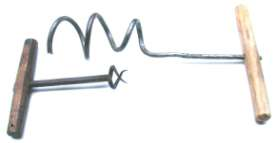
Two forged examples of patent variants. The
small unmarked double-helix on the left is a
variant of Schmeltzer & Roberts 1873 patent (it
was probably made earlier) and is well-sized
for apricots and dates. It is 8 inches ling overall
and the diameter of the prongs' sweep at the
tip is 1 1/2 inches. That diameter reduces
toward the handle, as the patent requires.
The unmarked single-helix lifter on the right is made of 3/8 inch round stock and has a
coil diameter of 3 inches at the tip, reducing in size toward the handle. Overall length is
15 1/2 inches. This appears to be a variant of Ragan's 1873 patent, although Ragan used
a 3/8 inch rod of square cross-section.