159
Fruit Lifters / Corkscrew Copycats?
by Bob Roger
1870 - Wanted: A tool that can be pushed down, twisted, and pulled to remove a barrier to a
container's contents.
You say the corkscrew has already been invented? Hmmm.
Dried apples, dates, figs, apricots, peaches and many
other varieties of fruits, sugar, and meats including
pork and fish (in brine or dried) were packed into
wooden barrels, and the contents were tightly
compacted when the barrel head was pressed into
position with a large screw-driven one-sided vise.
Then the barrels were shipped via sea, rail, and wagon
to the local mercantile, where the heads were removed
and the contents offered for sale. The shipping of
dried fruits in barrels had ended by 1900, although
sugar continued to come in barrels for a short time
after that (Reference:
―
Fruit Lifters
‖
, Laurence A.
Johnson,
The Chronicle of the Early American Industries
Association,
March 1957).
What you never saw in any
―
Western
‖
movie was how the grocer got the tightly-
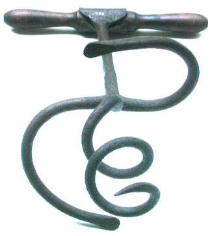
packed contents out of the barrel. What he did was pick up his trusty fruit auger, turn it
into the center of the mass a little way, and pull it out - just like pulling a cork out of a
bottle with a corkscrew. In fact, most of these implements resemble cork pullers but are
somewhat larger. With a small core removed, the sides of the hole could be loosened by
pushing them into the space vacated by the core. Other designs just loosened the
contents without pulling a core out.
Fruit lifter, dried fruit loosener, sugar devil, fruit auger - all of these names were used
by patentees to describe food-handling implements that were prominent in mercantiles
and general stores throughout the Victorian era, but which became obsolete around
1900. Strangely, they are also missing from many museums and implement collections.
The Patents
There were at least eleven U. S. patents for these tools, spanning about 25 years, and all
but two of the patentees were from the mid-West.