170
Glacial Screw!
by Ed Bystran
Recently I spotted a corkscrew (?) at a Reno, Nevada antique
store. I've noticed similar items, with the same offset handle,
for sale and always wondered why the handle was
constructed in an unsymmetrical shape. This one was priced
very reasonably so I bought it with the intention of doing
some research.
The antique dealer who sold me the screw showcased mining
paraphernalia. This item was labeled as a
―
LANTERN
HOLDER
‖
and I could visualize a mining lamp hung from it
in one of Nevada's old Comstock Lode silver mines.
On close inspection I observed
that the screw was marked
―
STUBAI MARWA AUSTRIA.
‖
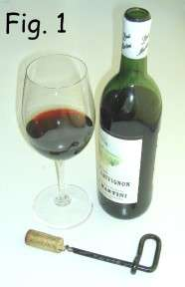
The item is not a corkscrew,
although Fig. 1 shows that it looks like a corkscrew and
works as a cork puller. Nor is it a silver-mine lantern
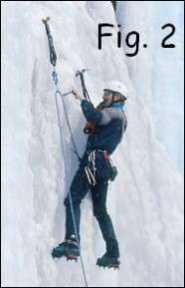
hanger. It is an ice screw that was used as a hanger and
safety anchor in winter alpine mountain climbing. Fig. 2
shows an alpine climber hanging from modern ice screws
on a vertical glacier face.
The item is a
―
Marwa
‖
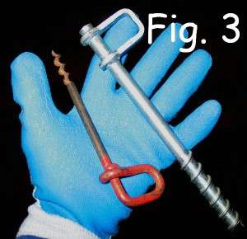
ice screw made by Stubai. This
style of ice screw has only a short history in Alpine
mountaineering. It was popular for a few years and was
quickly replaced by tubular ice screws. Fig. 3 shows a
―
Marwa
‖
alongside a first generation tubular screw.
The earliest forms of mountaineering ice protection
were stake-like ice pitons. The lead climber
hammered them into the ice and the followers
chopped them out. Unfortunately they sometimes
loosened and fell out when a climber moved above
them, creating the potential for disaster.
In 1960, a Swiss mountain rescue specialist named
Erich Friedli invented the first ice screw that was
actually twisted into the ice. It looked much like the
―
Marwa
‖
but was constructed of solid coat hanger-
like wire and, while evolutionary, it was difficult to