121
Retrievers
Did you ever push a cork into the bottle while trying to pull it out? Methods for
removing corks from inside bottles have been around for a long, long time. This article
is not intended to be all inclusive but to give an overview of cork retrievers. It spans the
period from 1863 through 1940.
Proctor Patent
Morrill Patent
Bielefeld / Schwartz Patent
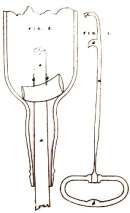
Stephen Proctor of York was granted British Patent No. 2,664 on October 28, 1863 for his
―
Improved Instrument for Extracting Corks from Bottles
.‖
The sharp hooks are
intended to cut up the cork if it is too large to go through the neck of the bottle and then
smaller pieces can be drawn out by the hook. Or they can be shaken out if small
enough. The Proctor extractor shows a graphic of the operation on the shank.
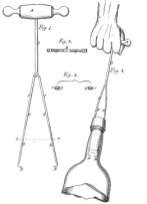
The inventions of Jesse Morrill of New York and Germans Francis Bielefeld and Charles
Schwartz are the earliest U. S. Patents for this type of cork extractor. Morrill's U. S.
Patent No. 42,784 was issued May 17, 1864. Morrill claimed
―
an improved cork drawer
with grooved prongs, or with grooved and serrated prongs.
‖
His two prongs would
sink into the sides of the cork taking up no more room than the cork coming through
the bottle neck.
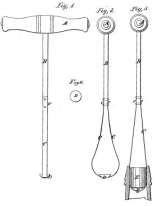
Bielefeld and Schwartz described the operation of their device,
―
We draw a cork from
the body of a bottle by first inserting the metallic spring, then turning the bottle neck
downward the cork falls into the neck, and by drawing the handle the cork is readily
withdrawn.
‖
U. S. Patent No. 47,161 was issued April 4, 1865.