76
While European inventors were filing for patents on air cork ejectors on a regular basis
in the 1960s, U. S. inventors were busy with gas ejectors.
It was as if there was a wait and see attitude on the
popularity of air ejectors.
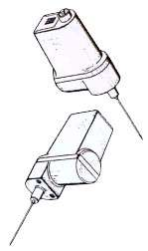
The first air design since Ludwig Eger's 1933 patent was
put on paper January 29, 1977 by Ted Essig in Noblesville,
Indiana. Essig received his Design Patent No. 252,972 for a
"Cork Extractor" on September 25, 1979. When asked if
his design was ever produced, Essig simply said "I'm sorry
to say that none were ever produced."
After Essig's design, American inventors were silent once
again.
_____________
It wasn't until 1982 that another American designed air cork
ejector came along. Alon Products, Inc., New York enlisted the
services of designer Fred Ravreby, Framingham, Massachusetts to
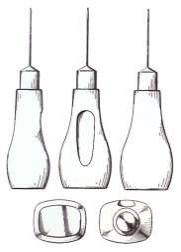
come up with a new cork removing product. On February 26,
1982 he filed his Patent for a "Cork Ejector" design and Des. No.
276,788 was granted December 18, 1984. "Pop-A-Cork" was a
registered trademark of Alon Products and was filed November
30, 1982.
Ravreby's "Pop-A-Cork" incorporated a small air pump powered
by four AA batteries. Ravreby said the product did not sell well
without demonstrations. He frequently set up at shopping malls
where he would insert the needle through a cork in a bottle and
depress the button on top to start pumping air into the chamber
between the cork and the wine. To the amazement of shoppers, the cork would slowly
rise and eject with a slight "pop." Ladies gladly forked over $15.00 for this gift for their
husbands. From 1983 to 1984 approximately
10,000 units were produced.
Ravreby and Alon had been beaten to the patent
office by a Japanese inventor who had filed on
October 31, 1980. His battery operated wine
cork remover was assigned Patent No. Des.
268,245 on March 15, 1983. The patent was first
applied for in Japan and details can be seen in the
section on Japan in this book.