124
Charles T. Simper's
―
Cork Pull
‖
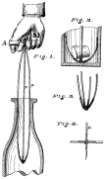
was covered by U. S. Patent No.
120,830 issued November 14,
1871. He explains the wires are
―
so placed that by turning the
handle to which they are attached
part of them fit inside of the others in order to permit a cork to enter into a concave
surface thus formed, when the cork is inclosed [
sic
] within the wires by turning the
handle back again, and thus held secure, may be pulled from the bottle.
‖
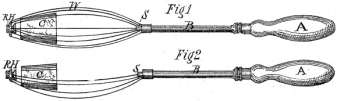
Another design incorporating a
corkscrew was conceived by
Charles Hunt. In his Patent No.
140,706 issued July 8, 1873, the
double spring loop slides into the corkscrew handle. Once the springs are inserted into
the bottle, Hunt says
―
... a cork which may have been driven into the bottle can be
caught in the loops and withdrawn very easily.
‖
Like Clapp and Gibson,
William Page and John
Fahy incorporated a
center spear in their
design. Following Clapp's example, their spear slides up and down and they
acknowledge Clapp's patent in their application. They claim the advantage of a
shoulder which
―
insures the prongs being forced down through the neck of and into the
bottle.
‖
U. S. Patent No. 164,731 was granted June 29, 1875.
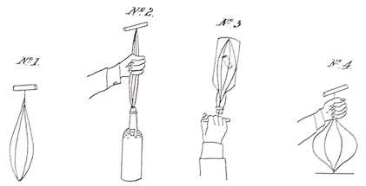
A new approach was taken by Australian Peter Tyrer in his U. S. Patent No. 199,760 of
January 29, 1878. Tyrer solders the wires at the bottom. Rather than explaining how he
actually traps the cork in the center, he simply refers to his drawings and says the cork
is taken as shown in figure 2.