63
Bifurcating
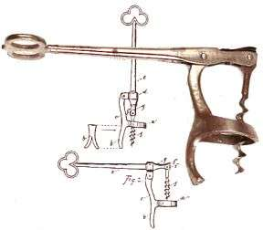
On September 3, 1878 William W. Tucker (Hartford, Connecticut) patented his
―
Improvement in Cork-Extractors.
‖
Tucker said to use his corkscrew, you start
with the handle in the vertical position, then you turn the whole assembly to
screw the worm into the cork. Once the
ring meets the bottle neck, the foot
engages the side of the bottle to hold the
device steady. The handle is then pulled
down and the cork is extracted.
In his application Tucker included an
interesting description of the foot:
―
...a
foot projecting downward, therefrom (the
ring) and bifurcated, so as to (in a limited
sense) embrace the neck of the bottle.
‖
I
was awestruck by the word
―
bifurcated
‖
so I had to look it up in our dictionary:
Main Entry: bi·fur·cate
Pronunciation:
‗
bI-(
―
)f&r-
‖
kAt, bI-
‘
f&r-
Function: verb
Inflected Form(s): -cat·ed; -cat·ing
Etymology: Medieval Latin bifurcatus, past participle of
bifurcare, from Latin bifurcus two-pronged, from bi- + furca
fork
Date: 1615
transitive senses : to cause to divide into two branches or
parts
intransitive senses : to divide into two branches or parts
- bi·fur·cate /(
―
)bI-
‘
f&r-k&t, -
‖
kAt;
‗
bI-
(
―
)f&r-
‖
kAt/ adjective .
My vocabulary increased one-fold but I
was not able to use it in a sentence.
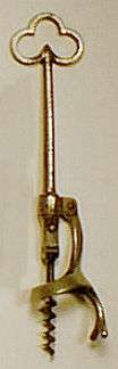
The patent shows a handle with three
―
holes
‖
as in the patent model shown at
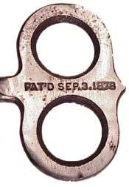
left. The production model has two holes
and is marked with the patent date between the holes.