162
A driving force in the ongoing development and
improvement of gas cylinders was Robert Hunter
Campbell of Edmonton, England. One of his early
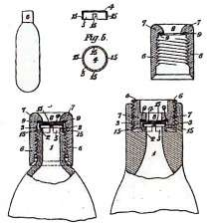
patent applications for a "Closure for Gas-Containers"
was filed with the United States Patent Office on April
22, 1910 (Patent No. 986,135). Of his invention he
writes:
My invention relates to containers, or capsules, for
compressed, or liquefied gas which is liberated from
the containers by piercing a closure, and the object of
my invention is to provide containers of the kind
commonly known as "sparklets" with improved and
very simple and economical closing means which will enable the container body to be
used repeatedly with facility and economy.
There it was - a trade name being used in generic terms much like tissues being called
"Kleenex" and colas ordered as "Coke." By this early stage, Sparklets had indeed
become a household word.
During the next two decades Campbell obtained
several patents for improvements to capsules. One of
the most significant was when he teamed up with
Harry Rudston Read and submitted on March 24, 1919
and application for "Improvements in and relating to
Syphon Fittings and the like." These two Sparklets
engineers developed a system for automatic extraction
of the capsule in order to extend the life of seals.
Read already had several Swiss patents to his credit
including one granted to him and Kenneth Murray in
1904 for a syphon.
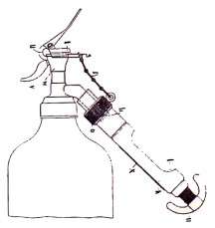
In 1932 Campbell and Sparklets Limited applied for an unusual patent, "Improvements in
Dental Spraying Apparatus." This type of apparatus was used to apply a medicament
dentifrice or other solution by using the gas cartridge syphoning system similar to those
used in soda syphons. Again the container is noted with "…of the kind commonly
known under the Registered Trade Mark 'Sparklet'."