161
grow and reached a peak in the 1960s and 1970s. They even found their way into
television with popular comic figures engaged in seltzer spray fights.
It has been said that as early as 1837, a man named Perpigna invented a soda syphon
incorporating a valve. And as far back as 1790, the concept of an "aerosol" was
introduced in France with self-pressurized carbonated beverages.
A number of European patents were granted for Soda Syphons
in the 19th Century including an important design using a gas
cylinder to charge the liquid. On August 22, 1892 Parisian
Victor Ernest Jules Durafort was granted French Patent
Number 223,985 for his "Seltzogene." This was followed by
patents in England (1893) and the United States (1895).
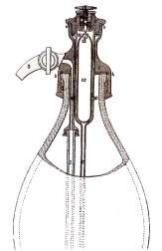
Durafort placed two dip tubes in the bottle. One would hold
the gas cylinder which was opened by turning a screw at the
top of the mechanism forcing a ball in the top of cylinder
downward and releasing gas into the tube. Once this was
mixed with the bottle contents, the valve on the second tube
could be opened to draw off
carbonated liquid.
A short time later, in 1899, Kenneth S. Murray of London was
granted British Patent No. 7,519 for his "Means for effecting
aeration of liquids in bottles." The patent was assigned to
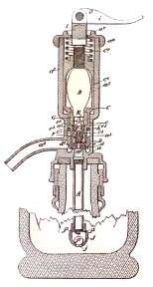
Aerators Limited. In his design, a "Sparklets" capsule was place
upside down and when a lever on top was depressed, a pin
would open the capsule valve and release gas into the liquid.
Twenty years later Kenneth Murray was a consultant to
Sparklets Limited as well as chief engineer to British Oxygen
Company. In 1920 he was a key player in the BOC acquisition of
Sparklets. He eventually became Chairman of the Board.