129
central position of the cork stopped with his/her naked eyes, if the needle slants to one side,
the syringe end cannot smoothly cover the bottle opening so that the subsequent inflating
operation cannot proceed smoothly. In case of forced displacement, the needle may deform
or even break.
4. The syringe and the refrigerant can are separately stowed, either of which may be
misplaced.
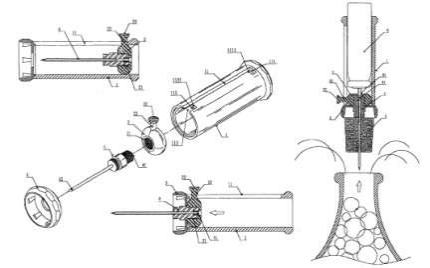
Chia-Hsien Lin addresses a bit of the problem with this partial description of the invention:
A safe and quick bottle opener for removing a cork stopper includes a hollow syringe in
which a refrigerant can is disposed. A cap covers and is concealed in the syringe. The syringe
has a slide sleeve sleeved thereon. The front end of the slide sleeve has an abutting seat for
covering a bottle opening. The slide sleeve helps positioning a needle and conceals the needle
to prevent slanting and breaking of the needle to thereby prolong the life of the bottle opener
and protect the user's hand. After use, the bottle opener can be assembled as a whole to
facilitate storage and carrying.
_______________________
Ms. Fen-Lan Lian of Taipei, Taiwan applied for a Taiwanese patent on her cork ejector on August 15,
2001. She received Taiwan Patent Number TW521754Y. She subsequently got Chinese patent
CN2494820U on June 12, 2002. She filed for a U. S. Patent in March of 2002 and on February 20,
2003 was granted Patent Number 2003-0033907. Here is a patent abstract:
A safe cork removing device for wine bottles has a hollow needle head, a refrigerant can
container, a sliding block and a seal cover. The sliding block is installed in the refrigerant can
container from an opening of refrigerant can container. The limiting rod is exactly positioned
in the longitudinal sliding groove of the refrigerant can container. The sliding block is movable
along the longitudinal sliding groove by operating the limiting rod. The hollow needle head can