160
splitting the holder, which is usually made of wood, during the operation of removing a
cap, and to prevent the dog from projecting outside the periphery of the holder when
the device is carried in the pocket
.‖
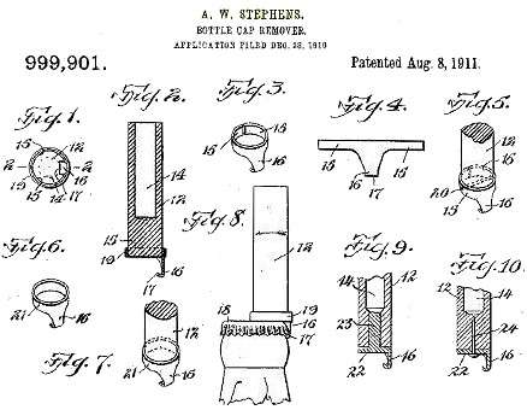
Stephens third patent for a modified corkscrew sheath (patent #999,901) was filed on
December 23, 1910 and issued on August 8, 1911. This was yet another variation on
Rockwell W. Clough's idea of attaching a cap lifter to the end of a corkscrew sheath.
Note that Stephens filed for both of these patents just months after Clough's Decapitator
hit the market. This strongly suggests that Stephens and Clough were well aware of
what the other was doing. Did Clough see Stephens as a competitor? Probably not.
After all, for each sheath that Stephens produced, he needed to buy a wire corkscrew
from Clough to fit into it. Clough probably viewed Stephens as a valued customer and
their business relationship was most likely quite amicable.