127
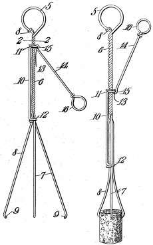
William Conner's July 14, 1908 U. S. Patent No. 893,055 is very
similar to Rosenberry's 1866 patent but with three prongs. He
suggests extra duty for his tool with
―
... it is obvious that the
same may be used with equally good results for cleaning
bottles, jars, large chimneys and the like by inserting a strip of
cotton, sponge or other soft material
between the fingers of the spring
arm
.‖
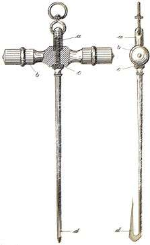
Hungarian János Borg received a
patent in Hungary on September 6,
1909 for his cork drawer which has a
big hook to fish for a fallen cork. On
April 27, 1910 he was granted French Patent No. 415,244 and
on May 18, 1910 British Patent No. 12,258.
In the U. S. patents of Clapp,
Gibson, and Page / Fahy a
center spear impales the cork to pull it up between the
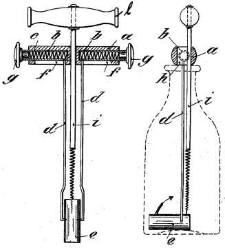
prongs. German inventor Helmuth Segger had an
interesting improvement on the concept. He used a
screw like spear to flip the cork in between two prongs.
A second handle with spring loaded buttons squeezes
the prongs together so the screw can be inserted into
the cork, secured by the prongs, and then extracted.
German Patent No. 333,808. was issued March 14, 1921
for
Korkenzieher mit hilfsvorrichtung zum Herauszeihen
von in die Flasche gefallenen Korken
(a corkscrew for corks
that have fallen into the bottle).
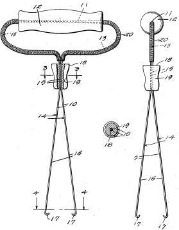
Moses Puccetti was granted U. S. Patent No. 2,145,129 on
January 24, 1939. He claimed his cork remover can remove a
cork from the neck or a cork that was forced into a bottle.
Like a prong puller, he says his tines are fed between the
cork and the bottle wall. He then slides the
―
follower
‖
(18)
down so the hooks grip the cork and then it can be
extracted. And then he goes on to a concern about the cork
falling into the bottle and says the tines are
―
relatively long
and will reach the cork and may be effectively engaged
therewith at the hooks
‖
! Evidently he didn't have much
faith in his intention to remove the cork from the neck.