116
Quirls
Every Victorian kitchen had quirls to 'fancy up' the presentation of food. Quirls are
another name for garnishers. They were used for cutting spiral shapes from root
vegetables (e.g. potatoes, beets, parsnips, turnips, carrots), fruit, etc. for ornamentation,
pickling, or frying).
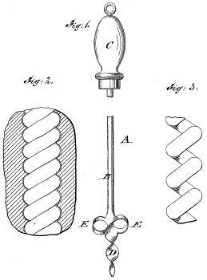
On March 19, 1872 John Blaettler of Philadelphia was
issued U. S. patent number 124,782 for a device for cutting
food into coils. His quirl has a single closed cutting edge
attached to an auger-pointed shaft. Although a circular
cutting edge is shown in the patent, he claims circular,
cross, star, and other shapes, and assigned the patent to
Herman Meyer of Philadelphia.
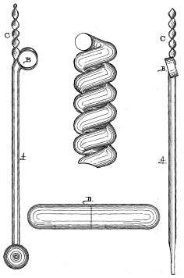
On February 16, 1875
Aime Vuillier of Newark,
New Jersey, was issued U.
S. patent number 159,869
for a similar tool having
two cutting loops.
With both of these implements, the cut spiral coils itself
up the shaft as the auger point pulls the tool into the
vegetable. To remove the spiral in one piece, the handle
is removed and the spiral slides off the end of the shaft.
The handle, therefore, was made to easily slide on and
off, and therefore often was separated from the tool
itself. That is why these items are usually found missing
the handle.
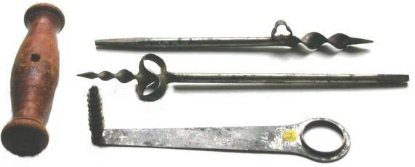
The top example at right
is Blaettler's patent with
a three-arc cutter and
handle at left. The
middle example is
Vuillier's patent without
a handle. Both are
marked GERMANY. The
bottom example is
Massari's patent and is
marked POPEIL PRODUCT.