94
which he swallows. Heretofore a straight piece of wood or other substance has been
employed to push the obstruction down the animal's throat; but in some cases it
destroys life, while it is attended with risk and more or less injury in all cases. The fruit
or vegetable has slipped past the muscles of deglutition in a nearly or quite entire state,
so that it is not in a proper condition to be forced down in to the stomach, and should
be brought back into the mouth for mastication and comminution. This is promptly and
completely effected by my invention.
‖
The operation of the tool should be obvious to the reader in the above drawing.
Samuel's claim is
―
A sharp-pointed spiral or corkscrew, combined, slidingly and
rotatingly with a surrounding tube, the latter adapted to be moved up against a potato
or analogous substance in the throat of an animal, and the former to rotate until it takes
a sufficient hold, as and for the purpose specified.
‖
U. S. Patent No. 319,454 was granted
June 9, 1885.
Over a hundred years later, McPherson, Saye, and Reddick obtained a patent for a tool
having properties very similar to Cochrane's 1885 design. However, the threesome did
not intend their tool for use in removing potatoes stuck in an animal
‘
s throat, rather
theirs is intended for use as a surgical instrument. Their
―
Method of Using a Coil Screw
Surgical Retractor
‖
was granted U. S. Patent No. 5,573,496 on November 12, 1996.
The drawing pictured above had a catchy title
―
Device for Curing Chickens of the
Gapes
.‖ You
shove that spiral down the chicken's throat and twist it to extract worms
stuck there. Robert Walker was granted U. S. Patent No. 343,145 on June 1, 1886.
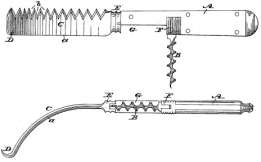
This combination tool patented by John Stone
includes
―
A green-corn grater, vegetable parer and
gouge, and a corkscrew
.‖
Stone notes that the
gouge can be used for removing eyes and specks
from potatoes and other vegetables. Convinced
that all reading his application would understand
the corkscrew, he simply wrote
―
The use of the
corkscrew is apparent.
‖
U. S. Patent No. 342,884
was granted June 1, 1886.