70
We are informed that it has been examined by President Lincoln, ex-President Fillmore,
Gen. Mansfield, Gen. Miegs and other competent authorities, who have given it their
fullest endorsements.
Mr. Parr, who seems to be fertile in getting up convenient things, has also invented a
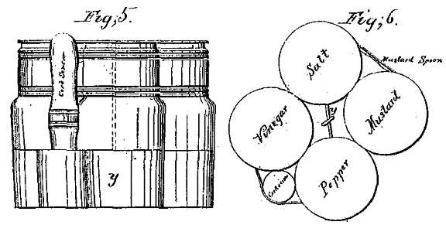
canteen case, which, like the camp chest, has a cruet stand for pepper, salt, vinegar and
mustard;
mustard spoon and corkscrew combined
, knife and fork, spoon, tea caddy,
drinking cup, apparatus for boiling tea and coffee, with fuel sufficient for 20 meals. This
light, convenient and useful article is enclosed in a leather case, nicely finished, and is
designed to be suspended from the shoulder by a leather strap in the same manner as a
cartridge box.
Altogether, these arrangements of Mr. Parr are unique and useful, and as such we can
recommend them to the soldiers of our army.
The patent for this invention was granted June 25, 1861; and further information in
relation to it may be obtained by addressing the inventor, George Parr, at Buffalo, N. Y.
Although the Scientific American article alludes to a
―
mustard spoon and cork screw
combined
‖
, Parr's
patent description
is
―
... containing
vinegar, salt,
pepper, mustard,
cork screw and
mustard spoon, as
marked in the
drawings
‖
. The
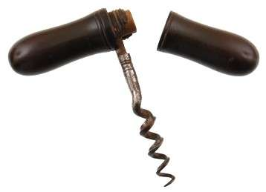
corkscrew drawing
shows what is
apparently a
Goodyear corkscrew*.
*On May 6, 1851, Nelson Goodyear was granted
U. S. Patent No. 8,075 for his
―
Improvement in the
Manufacture of India-Rubber.
‖
The patent details
the process but does not specify a corkscrew or
any of the other products manufactured of India
Rubber. However, the roundlet corkscrew can be
found with the marking GOODYEARS PATENT
1851. Goodyear extended his patent in 1865 to an
expiration date of May 6, 1872.