62
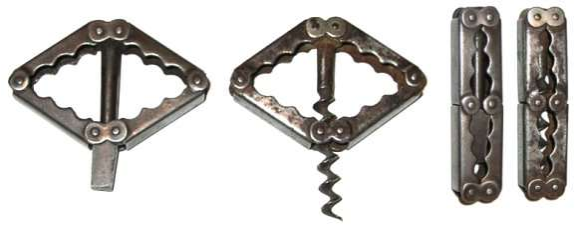
On February 25, 1891 Carl Hollweg of Barmen, Germany was granted U. S. Patent
447,185 for his collapsing corkscrew. Hollweg noted that the handle of his corkscrew
acts as the protecting sheath keeping pockets from ripping. The corkscrew handle is
composed of four pieces which are connected at the ends forming a toggle-joint with
gears. The screw-shank is secured to the handle at one of the joints. The flats on the
handle can be used for advertising purposes. There is no mention in the patent for other
uses for his collapsing design, however, above is an example produced with a carriage
key.
Can opener with carriage key and corkscrew
So how are these carriage keys used? Bob Roger enlightens us in the story below.
Using Carriage Keys
by Bob Roger
For the privileged, travel during the Victorian era was usually by ship, carriage or rail.
Passage ways on the ship and in railroad coaches were tight, and doors to private
compartments or staterooms did not have exterior knobs or handles. An exterior door
handle on a carriage would get muddy during the trip, and was therefore not used on
carriages either. To open a handle-less door latch, the porter would insert his
―
key
‖
into
the square opening left vacant by the missing handle and shaft, turn it to release the bolt
or catch, and open the door. A handle might be used on the interior of the door to