25
The American Corkscrew Company
On February 9, 1911 Joseph T. Bethel of Manchester,
Virginia applied for a patent for a corkscrew. He
wrote:
―
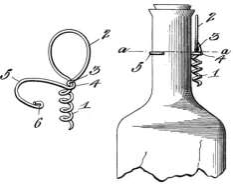
This invention is an improved cork screw made
from a single wire and provided with an integral
clamping arm on one side for engaging the neck of a
bottle so as to secure the cork screw thereto, and
keep the cork screw with the bottle and keep it from
being lost.
‖
Bethel further notes
―
Heretofore it has been the common practice in packing bottled
goods, which are provided with cork screws to secure the cork screw to the neck of a
bottle by means of an elastic rubber band or the like
‖
(shown in photo).
Bethel was granted U. S. Patent Number 1,009,040 on November 21, 1911. It was
assigned to the American Cork Screw Company, Incorporated of Virginia.
The Company
On June 15, 1911 five people applied for a Virginia Corporation Charter giving their
residence addresses in the downtown Richmond vicinity:
R. L. Mahaley, President
James C. Page, Vice President & Counsel
Joseph T. Bethel, General Manager
G. H. Knight, Secretary
D. M. Burke, Treasurer
The purposes for the formation of the Corporation to be known as the
―
American
Corkscrew Company, Incorporated
‖
were cited as
―
...to obtain Letters (of) Patent in the
United States and its dependencies and in Foreign Countries and for the manufacture
and sale of a certain corkscrew and the machines for the making of the said corkscrew
and the general manufacture of metal specialties. The said corkscrew is described by the
Commissioner of Patents as follows: 'A corkscrew constructed from a single length of
wire bent to form a finger loop and two arms, of which one is twisted to provide a
corkscrew, and the other is coiled around the neck of the loop to reinforce the same, and
thence extended at right angles to the corkscrew and bent to present an approximately
semi-circular neck engaging band, the terminal of the latter being formed into an eye
that is offset from the neck to facilitate detachment and also by contact with the neck to
accentuate the clamping property of the band.'
―