153
Snaffle
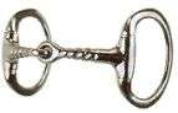
The item pictured above is described as
“
Eggbutt Dee 1/2 inch Tapered Stainless
Steel Corkscrew, 3 inch cheeks, 5 inch mouth.
”
This corkscrew commonly
referred to as a
“
snaffle
”
is designed to discipline or school a horse.
There are six common types of corkscrew snaffle bits: Dee ring snaffle, Egg butt
snaffle, Loose ring snaffle, Full cheek snaffle, Driving snaffle, and Full cheek
snaffle with twisted wire mouthpiece.
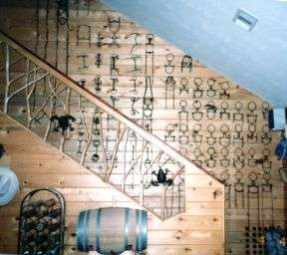
Corkscrew collector Don Minzenmayer writes
“
I enclose a photo of our country
house at the vineyard showing the wall behind the stair. On the left side of the
picture you will see about a dozen
„
snaffle
‟
bits showing most of the six types
you mentioned plus a few other bits. My main interest here is not the
„
snaffle
‟
bit
but the
„
Ring Bits
‟
. About 40 of them are on the right half of the picture.
You mentioned that the snaffle was designed to discipline or school a horse. The
ring bit is not used today except maybe
in some parts of Mexico. The RB has a
spade that pulls up into the roof of the
mouth and the ring slips over the lower
jaw. When the reins are pulled there is
pressure put up into the mouth and the
ring applies pressure on a nerve under
the lower jaw. Not too kind but the
horse learns very quickly that if he
behaves himself, the hurt will go away.
These were used to instantly control a
wild horse without breaking it, also on
mules, donkeys and jacks with a mind
of their own.
The ring bit was first used by the Moors in North Africa and brought to Mexico
sometime in the 17th and 18th century. Each one is different, handmade to fit the
animal that needs it. The U. S. Calvary even used them during the Civil War and
shortly after. They could catch and ride wild horses in a very short time with
these bits. Many of the ones you see in the photo are over 200 years old. Some are
more recent and one that I am especially proud of is from the 17th century.