179
In his discussion of prior art, Artmer considered the 1950 French invention of Gabriel
François-Antoine Cognet. Cognet penetrated the cork with a worm and then used
liquid in a piston arrangement to extract
it. Artmer
says "…the cork is extracted by
a single stroke of the pump and so, in order
to exert the necessary force, the stroke of
the pump must be long, thereby rendering
the bottle opener extremely clumsy." An
alternative suggested by Cognet would
require several strokes of the pump.
Artmer continues with "…it is highly
dubious whether such a bottle opener
would be capable of functioning under
practical conditions."
Artmer then addresses the gas cartridge
ejectors with needles. Referring to the
1963 Swiss Kisag Patent, he says, "Because
the cannula must be sharpened to a point,
a danger of injury or damage exists…the
gas…influences the liquid present [
in the
bottle] because the gas customarily used
dissolves in the wine." His most scathing
remark comes just before the
presentation of his idea: "…the most
serious disadvantage to this type of bottle
opener is that many bottles cannot
withstand the pressure of gas which builds
up and explode. This can lead to
extremely serious injuries; bottle openers of this type cannot be sold in a number of
countries for this reason."
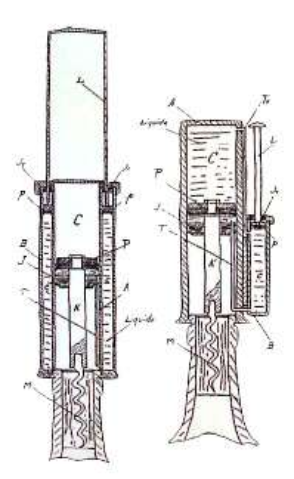
Artmer used a gas cartridge in his invention, the Mister Maximum, but says, "Unlike all
similar devices M. M. produces no pressure in the bottle! A tube acts on the lip of the
bottle and lifts up the cork!" He uses a worm attached to one sliding part combined
with another sliding part containing the CO2 cartridge and release mechanism. To best
describe how it works after the worm is screwed into the cork, here's the copy from
Mister Maximum:
For those interested in the technical side, the operation can be explained as follows: By
pressing the button, CO2 is forced under pressure into the M. M. and the tube is
pushed out. But the tip of the bottle resists the motion of the tube, so that the
corkscrew pulls out the cork.
Artmer also obtained patents in Australia (AU4758872), Belgium (789999), France
(2156713), Germany (2246062), Italy (969755), Netherlands (7214281), South Africa