177
Mister Maximum
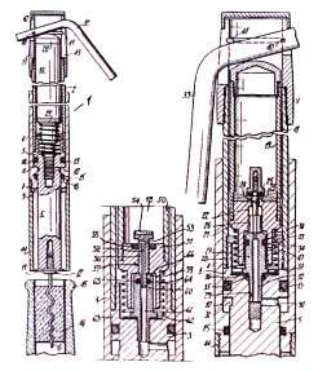
Jean Rochat of Geneva, Switzerland
invented another way to use the gas
cylinders to extract a cork. This time,
however, the gas did not enter the
bottle. The gas was used to move a
piston, which would pull the cork out
of the bottle after it had been
penetrated by a worm. Rochat applied
for a Swiss patent on November 7,
1963, which was granted September
15, 1965 (No. 399,219). In 1966 his
idea was patent in Germany as well.
Before detailing his invention, Rochat
points out that cork ejectors with
needles are well known but dangerous.
His complicated mechanism then takes
three pages to explain. Simplified it
works like this: The whole unit is
turned to insert the worm into the
cork, moving the lever causes the gas
cartridge to make contact with a spindle which opens the valve, the gas pushes the top
piston away from a shoulder, and the worm and cork are then pulled into the bottom
cylinder.
_________________
After studying this patent, Austrian inventor Gero Artmer commented:
1. I never saw a production model and doubt that it was produced.
2. It is hard to screw the worm in. The description says the actuation lever can
help the grip but this could be dangerous when touched.
3. In opening a bottle, it is suggested that the lever be pushed carefully - there is
no safety valve.
4. Mechanically it is very complicated. There are too many chances for
malfunction and the cost to produce would be prohibitive in a competitive
market.
Throughout the 1960s, air and gas cork ejectors were popular and a well accepted
method of removing a cork. They were simple and easy to use. Rochat's expensive idea
would not have a chance for survival during that time period. By the 1970s, ejectors had
begun to receive some bad, and likely unfounded, press. There are references to bottle