146
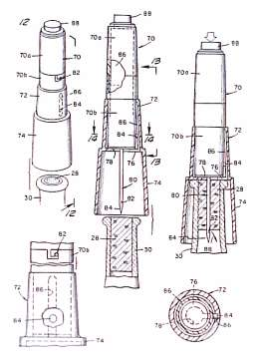
A “Cork Removal Apparatus” invented by
Helmut Reinbacher, Canoga Park, California,
was designed to use either an air pump (see the
United States air ejector section) or gas. By the
time he filed for a patent on his on February 5,
1990, the “Cork Pops” had gained a strong
foothold on the market. His patent application
includes details for a means for removing the
cork from the needle once it was inside the
“safety shield.” He accomplished this by
placing a disk with two ears on the needle and
riding up and down on the slots in the shield.
Once the cork was ejected, the two tabs could
be pushed down to get a head start on removing
the cork from the needle. This had already been
done with the Cork Out in the early 1980s and
on late 1980s Cork Pops.
In his patent background data he badmouths the
corkscrew with “For many years corks were
typically removed from bottles, such as wine bottles, through the use of a cork screw.
This practice had many drawbacks, including being cumbersome, and inefficient.
Additionally, the cork screw would often times break or crumble the cork, contaminating
the contents of the bottle.”
Reinbacher licensed his invention to Pop A Cork, Inc., Los
Angeles, California who sold it as “Quick, Easy &
Irresistible” with a notation that “it injects a food grade
gas” (the same A-108 propellant used in the Cork Out)
thus dispelling any concerns about spoiling the wine. They
made no guarantee that it would work every time and even
stated in their instructions: “Depress button…If cork has
not risen after 6 seconds, use a conventional corkscrew” –
a product that Reinbacher said was cumbersome and
inefficient!