135
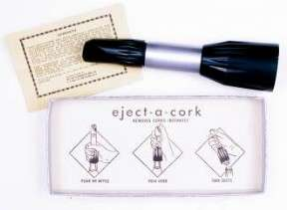
Within a short period of time Neo Valve Products En'g Co., P. O. Box 155, Martinsville,
New Jersey undertook some major changes and introduced the "eject-a-cork." The
instruction sheet has a 1963 copyright date. These are marked Made in U. S. A. on the
lever and with the exception of the added shield around the needle, the product basic
product design is the same as the early Corkmaster and Cork-Ace. There were three
different models of the eject-a-cork: silver and gold finishes with a metal head and plastic
lever and brushed chrome with a plastic head.
In the section on England, it is noted that
early Corkmasters had a needle that was
only 1 5/8" long. Surprisingly, the eject-a-
cork needle is a mere 1 1/4" long (the
standard cork ejector needle is in the 2 to
2 1/2" range). Instructions explain this with
"The cork-pin does not have to protrude
entirely through the cork. The cork is
porous and the pressure will go through,
around and below the cork ejecting it easily
if directions have been followed carefully."
In addition, the eject-a-cork has a "hub
area" which, when seating the shield, pushes the "cork slightly down into the bottle
releasing any sugar seal. Regarding short needles, in "The Reluctant Cork" in a
newsletter published by Almadén Vineyards, Los Gatos, California, Frank Schoonmaker
commented:
…early models of such extractors had grave faults
- too short needles, which injected
gas into the cork rather than under it, gas cartridges with too high pressure, which
provoked something more like an explosion than like the gentle and reverent opening of
treasured old wine.
It is quite likely that the New Jersey eject-a-cork had a very short life.
______________